A restaurant in Fallbrook Village can lose a walk-in and limp through a service with ice and coolers. It cannot lose its dishwasher. When the under-counter or door-type machine stops, or stops sanitising, the kitchen is either washing by hand at three-compartment-sink speed or it is closed, and the health code has an opinion about which. This guide covers why dishwasher downtime is so expensive, how sanitiser rinse temperature compliance works and fails, what differs in maintaining Hobart, CMA, Champion, and Jackson machines, the water treatment that commercial dishwashers need in Fallbrook, and what a maintenance contract buys.
Why commercial dishwasher downtime shuts restaurants down
A commercial dishwasher is a sanitising machine that also happens to wash. Its throughput is what lets a small kitchen turn plates and glassware fast enough to serve a full dining room, and its sanitising rinse is what lets the restaurant demonstrate to an inspector that ware is safe. Lose either and the restaurant is in trouble within the hour.
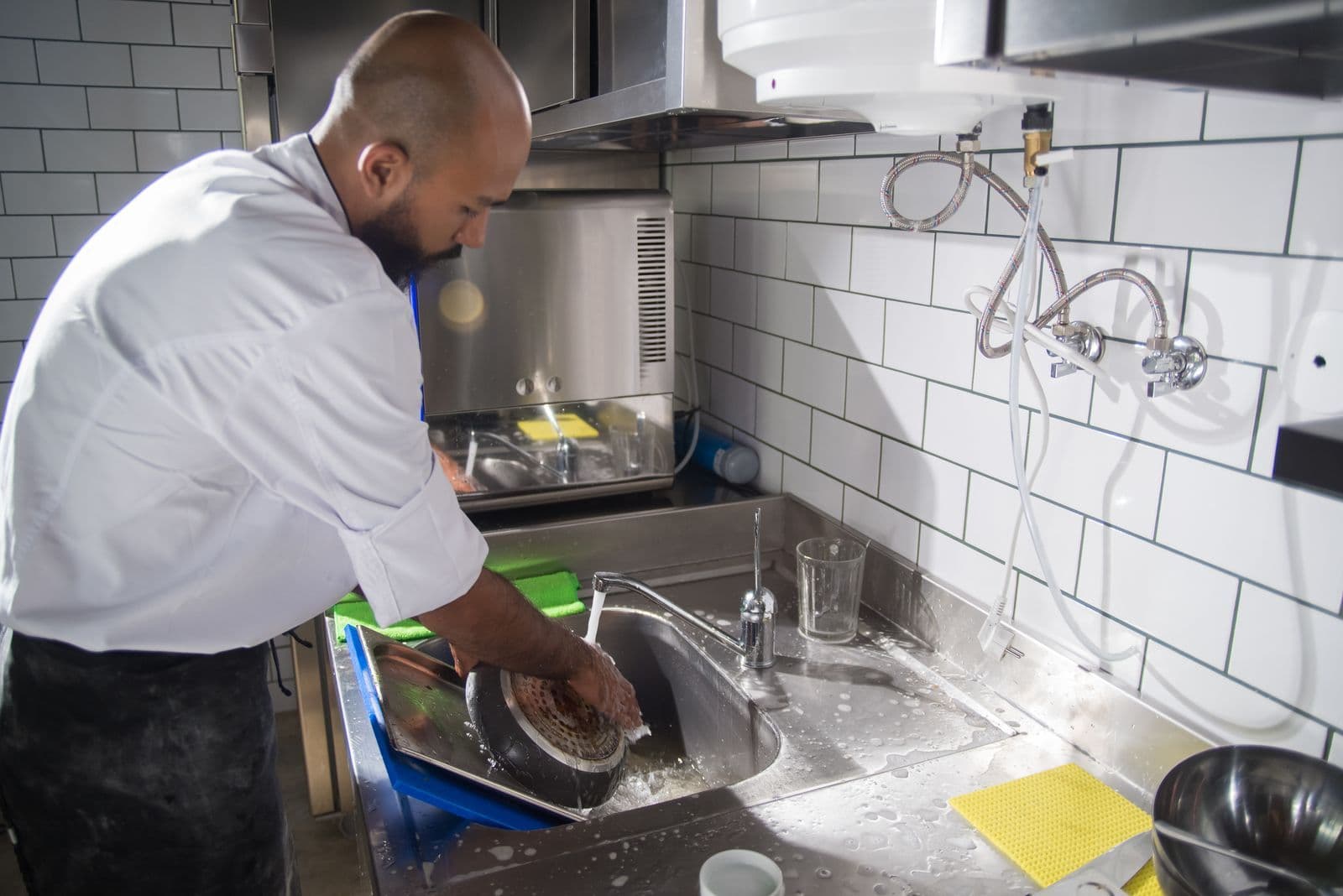
When the machine stops entirely, the fallback is the three-compartment sink: wash, rinse, sanitise, with a chemical or hot-water sanitising step that staff have to time and test. It works, it is what the code allows, and it is a fraction of the speed. A Friday dinner service on a three-compartment sink means a dish backlog, cold food waiting for plates, and someone pulled off the line to wash. Many Village restaurants do not have the staff to spare.
When the machine runs but does not sanitise, the situation is worse because it is invisible. A high-temperature machine with a tired booster heater will wash and rinse normally while the rinse temperature sits twenty degrees short of the requirement. A low-temperature machine whose chemical dispenser has stopped priming will run cycle after cycle with no sanitiser at all. The ware looks clean. It is not sanitised, and the inspector's thermometer or test strip will show it. The San Diego County Department of Environmental Health inspects food facilities against the state retail food code, and a dishwasher that cannot sanitise is the kind of finding that can take a facility out of service until it is fixed.
That is why the response commitment for commercial calls is different from residential. A dishwasher that has failed or cannot sanitise at a food service operation is a genuine emergency and is dispatched the same day regardless of the time received; routine commercial calls before 2 pm get priority dispatch, and Fallbrook Village is typically reached in 45 to 90 minutes.
Health department sanitiser rinse temperature compliance
Commercial dishwashers sanitise in one of two ways, and compliance is checked differently for each.
High-temperature machines sanitise with heat. The wash runs around 150 to 160°F, and the final rinse is boosted to a sanitising temperature, typically 180°F at the rinse manifold, which produces a surface temperature on the ware that the code treats as sanitising. The machine's data plate states its required wash and rinse temperatures, and the booster heater, a small tank heater built into or beside the machine, is what lifts incoming hot water the last 40 degrees or so. Compliance is shown by the machine's rinse thermometer or gauge, and inspectors verify it with their own thermometer or a temperature-indicating label run through a cycle.
Low-temperature machines sanitise chemically, usually with a chlorine solution dosed into a final rinse at around 120°F. Compliance is shown with a test strip on the rinsed ware, and the machine depends entirely on its chemical dispenser pumping the right concentration every cycle.
The failures that put a restaurant out of compliance follow from that.
On a high-temp machine, a booster heater element that has burned out or scaled over, a booster thermostat that has drifted, a rinse valve or pressure regulator that delivers too little water, or incoming hot water that is below the booster's design inlet temperature all leave the rinse short. So does a rinse thermometer that has failed and reads high when the rinse is cold. On a low-temp machine, a dispenser pump tube that has perished, a chemical pickup that has lost prime, an empty sanitiser container that nobody noticed, or a dispenser calibrated for a different concentration all leave the rinse without sanitiser.
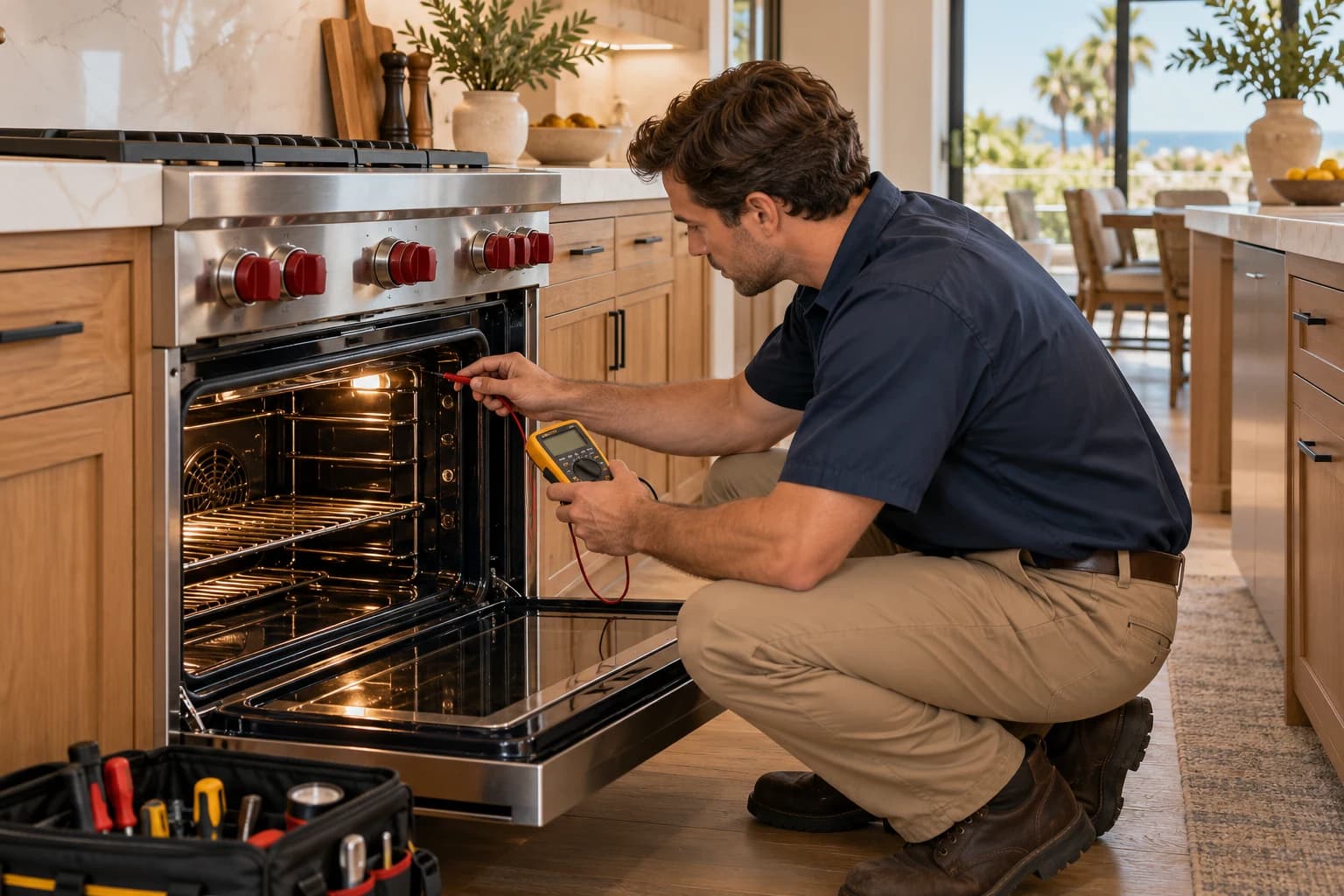
Daily checks by staff catch most of this: read the rinse gauge on every cycle, test-strip the ware on low-temp machines at the start of each shift, and log it. A technician's visit verifies rinse temperature with a reference thermometer at the manifold and on the ware, tests booster heater performance and recovery, checks rinse arm pressure, and on low-temp machines calibrates the dispenser and tests the result. Documentation from those visits, with the readings, is what an operator shows an inspector who asks when the machine was last verified.
Hobart, CMA, Champion, Jackson maintenance differences
The four brands common in Fallbrook Village under-counter and door-type installations do the same job with different habits.
Hobart. The most common machine in the area and the benchmark. Hobart under-counters and door-types are robust, parts are well supported, and the control systems on newer models give useful diagnostics. Their booster heaters are often built in, which makes the booster a service item on the machine rather than a separate unit, and their wash pumps and drain pumps are the wear points at volume. Descaling frequency drives longevity more than anything else on a Hobart in Fallbrook.
CMA. Common in smaller operations and often configured as low-temperature chemical-sanitising machines. The chemical dispensers, their peristaltic pump tubes, and the pickup lines are the maintenance focus, along with the drain pump. Dispenser calibration and tube replacement on a schedule keep a CMA in compliance.
Champion. Door-type machines are the usual Champion installation locally. Rinse arm nozzles, door interlocks, and the booster on high-temp units are the recurring items, and door-type machines generally see more mechanical wear at the door and gasket from constant use.
Jackson. Under-counter and door-type, both high- and low-temp configurations. Similar service profile to Champion, with attention to the wash arm bearings and the rinse valve.
Across all four, the components that fail are the same: heating elements on electric booster and wash tank heaters, gas boost on some installations, drain pumps, water inlet valves, door interlock switches, wash and rinse pumps, and on low-temp machines the sanitiser dispenser. The brand determines the part number, the access, and the control logic, not the list. Repairs on all four are within scope, with the commercial diagnostic at $135 applied to the repair and labour at $135 per hour minimum. For a household machine rather than a commercial one, the equivalent story is on the dishwasher repair page.
Water treatment for commercial dishwashers
A commercial dishwasher uses a large volume of water per cycle and runs many cycles a day, so whatever is in the water accumulates fast. In Fallbrook Village most restaurants are on Fallbrook Public Utility District supply, at roughly 80 to 130 ppm hardness, which is moderate and manageable with regular descaling. Operations outside the Village on private wells, caterers and grove-side kitchens among them, face water that can exceed 300 ppm, and their machines scale on a schedule that surprises operators used to municipal water.
Scale has three effects on a dishwasher. It coats the heating elements in the wash tank and the booster, so they take longer to reach temperature, draw more power, and eventually fail, and a scaled booster is the commonest reason a high-temp rinse falls short of compliance. It blocks the rinse arm nozzles, reducing rinse pressure and coverage so ware comes out spotted and, worse, under-sanitised. And it leaves the white film on glassware that customers notice. Well water adds sediment that fouls the inlet valve and corrosion that attacks the valve and elements.
The response has two parts. First, descaling on a schedule: monthly on FPUD supply at restaurant volumes, and more often on well water, using the manufacturer's recommended descaler through a full cycle with the machine empty, followed by nozzle inspection. Second, treatment on the machine's supply where the water justifies it: a scale-inhibiting or softening stage sized for the dishwasher's throughput, and on well water a sediment pre-filter ahead of it. For well-served commercial operations the payback across reduced service calls and extended booster and pump life is typically under two years. The dishwasher and any ice machine on the same supply usually share the problem and can share the treatment; the broader picture is under well water appliance service. Appliance Repair Fallbrook does not sell water treatment, so the recommendation is to have the supply tested and specify to the result.
Preventive maintenance contract value
A preventive maintenance contract for a Fallbrook Village restaurant covers the dishwasher alongside any refrigeration and ice machine on the premises, with quarterly visits. On the dishwasher each visit includes descaling, verification of wash and rinse temperatures against the data plate with a reference thermometer, booster heater performance testing, rinse arm pressure and nozzle inspection, inlet valve and drain pump checks, door interlock and gasket inspection, and on low-temperature machines dispenser calibration with a test-strip result. Components approaching end of life, a drain pump that is getting loud, an element that is scaled beyond cleaning, are identified for scheduled replacement. Pricing is per piece of equipment, and the contract reduces the diagnostic fee on any additional service calls during its term.
The case for it is the cost of the alternative. A dishwasher that fails during Friday service costs the diagnostic, the repair, and a service's worth of three-compartment-sink labour and backed-up tables. A dishwasher that fails a sanitising check costs all that plus the inspection finding. Against that, four scheduled visits a year with the rinse temperature verified and logged each time is a modest sum, and the visit records are exactly the documentation an inspector asks to see.
For Fallbrook Village restaurants, cafes, and food service operations, commercial appliance repair calls are routed for priority when identified as commercial at the outset. Call (951) 717-8971 with the business name, address, the machine's brand and type, and what it is doing; a machine that cannot sanitise is dispatched the same day. Invoices carry model and serial numbers, parts installed, technician identification, and the repair timeline for health department, insurance, and warranty purposes.