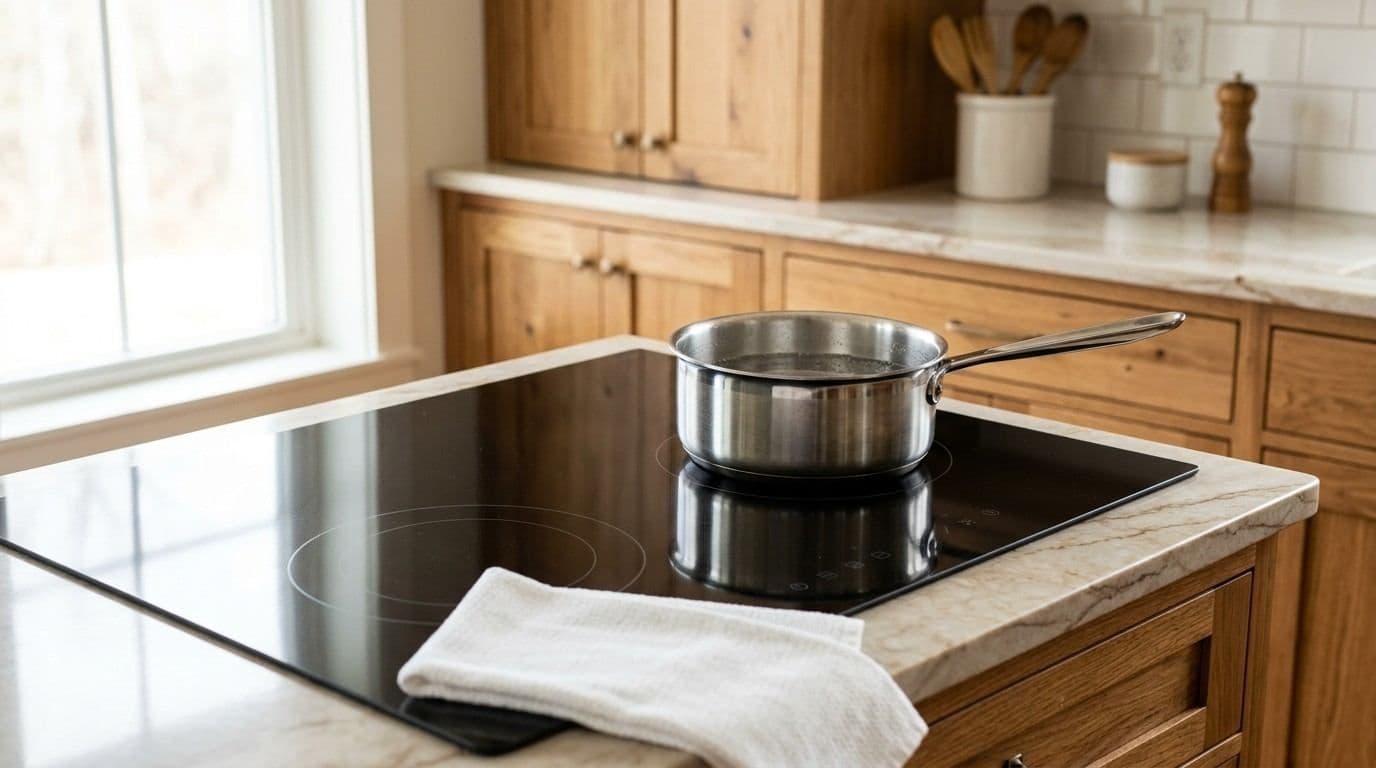
Most scratches on a glass top stove come from sliding pans, rough or dirty pan bottoms, and grit trapped under cookware. They are cosmetic. Cracks and pitting come from different causes: impacts, heavy weight, hot sugar or melted plastic, and sustained overheating.
Four habits prevent most of the damage:
- Lift pans instead of sliding them.
- Check pan bottoms: clean, flat and the right size for the element.
- Scrape hot sugar or melted plastic off right away.
- Keep heavy or breakable objects off the cooktop, and don’t store them where they could fall onto it.
The distinction that matters most: a scratch is cosmetic, but a crack or pit is not. AEG’s support guidance says scratches can’t be undone and don’t affect how the hob works. It says cracked glass means stop using it, unplug it if possible, and book a technician.
The rest of this guide helps you identify your damage, prevent more of it, and decide what to do next.
Is it a scratch, residue, or a crack?
Many “scratches” aren’t scratches at all. Clean the glass properly first (see the cleaning section below), then judge it.
- Gray or dark streaks: usually metal residue from aluminum or copper-bottom pans. It cleans off if treated promptly. Cosmetic.
- Fine lines that stay after cleaning: true scratches from sliding, rough pan bottoms or grit. Permanent but cosmetic.
- Dark burnt-on patches: spills heated repeatedly. Cosmetic, but they get harder to remove. Clean them before the next use.
- White haze, spots or rings: mineral deposits left by evaporated water. Cosmetic.
- Blotchy look on light-colored glass, only while hot: GE describes this as normal and temporary.
- A rough patch, pit or dent: usually hot sugar or melted plastic. This needs service, and GE says pitted glass must be replaced.
- Any crack, chip or spider-web pattern: stop using the cooktop.
Can scratches be removed? Don’t count on it. True scratches are permanent. Marks that clean off, such as metal residue, were never scratches in the first place. Retailers sell touch-up kits, but we found no manufacturer guidance recommending them. Ask before using one on a cooktop under warranty.
Check warranty coverage too. AEG says superficial scratches aren’t covered. GE’s owner’s manual excludes sugar pitting unless the spill was removed while still hot, and it also excludes accidental damage.
What your glass top is made of
Smooth tops use glass-ceramic, not ordinary glass. The same kind of panel can sit over radiant elements, induction coils or gas burners. GE’s cracked-glass guidance covers radiant, induction and gas-on-glass tops.
Two points shape everything below:
- It’s built to resist heat, not abrasion or impact. Schott, which makes CERAN panels, says its material has low thermal expansion and high resistance to thermal shock.
- “Scratch-resistant” is not “scratch-proof.” GE’s manual describes its glass exactly that way.
What actually damages a glass top stove
Well documented:
- Impact. Dropped pots, jars and heavy objects. Impact cracks typically spread outward from the point of impact in a spider-web pattern.
- Hot sugar, plastic and foil. If they cool on the glass, they can bond to it and cause pitting.
- Weight. GE warns that children should never climb, sit or stand on the cooktop.
- Sustained overheating. Heat trapped by oversized cookware can discolor or crack the top. Boiled-dry pans can also fuse to it.
Less certain:
- Scratches weakening the glass. Some repair-company pages say accumulated scratches lead to cracks. We found no manufacturer support for that, and AEG says scratches don’t affect operation. A chip or deep gouge deserves inspection. Fine surface scratches look cosmetic.
Does a sudden temperature change crack a glass top?
For an intact top, manufacturer evidence says abrupt temperature change isn’t the main risk. A pan going onto a cold cooktop is what the material is designed to handle. Heat does matter in other ways:
- Trapped heat. Missouri Extension says an oversized canner reflects extra heat back onto the top. That can discolor it, damage the burner area, crack the glass or fuse the pot to it.
- Lids left on the glass. AEG advises against leaving lids on the glass to cool. GE notes that wet lids and pans can stick as the glass cools.
- Cookware, not the cooktop. GE warns that only certain glass, ceramic and glazed cookware tolerates sudden temperature change without breaking.
Waiting for the top to cool before cleaning is still right. The reason is practical: a wet cloth on a hot surface can cause steam burns, and some cleaners give off fumes when applied hot.
A chipped or already-cracked top is no longer undamaged glass. Treat it as damaged.
Prevention habits that matter most
- Never let hot sugar or melting items sit. The steps are in the next section.
- Set pans down; never drop or bang them.
- Lift pans; don’t slide them. This prevents most scratches and metal marking.
- Check pan bottoms. They should be clean, smooth and flat. GE suggests laying a straight edge across the base.
- Match the pan to the element. It should cover the element and not overhang by much.
- Keep pans and lids dry. Don’t leave lids sitting on the glass.
- Never heat empty pans or let them boil dry.
- Keep sharp and meltable things off the glass, even when the cooktop is off. That includes knives, rings, plastic and foil. Don’t cook food directly on it.
Which cookware is safe on a glass top?
Check your own manual first, because brands differ. GE’s owner’s manual for its radiant glass cooktops gives this guidance.
Recommended:
- Stainless steel.
- Heavy aluminum (wipe off residue promptly).
- Copper-bottom pans (never let them boil dry).
- Enameled cast iron with a smooth, coated base.
Not recommended:
- Thin aluminum.
- Enameled steel, because the enamel can melt onto the glass.
- Bare cast iron.
- Stoneware and glass-ceramic cookware.
- Woks with support rings.
Can you use cast iron on a glass top stove?
Online advice disagrees, and owners report mixed results. GE says bare cast iron isn’t recommended and will scratch. If you use it anyway, the risk is yours.
- Clean and check the bottom first.
- Set it down gently.
- Never slide it.
Enameled cast iron with a smooth coated base is a different matter, and GE lists it as recommended.
Hot sugar, melted plastic and canning
The hot-spill steps
This is the one situation where scraping a hot top is correct. GE’s steps are:
- Turn off all elements and remove hot pans.
- Wearing an oven mitt, use a single-edge razor scraper to push the spill to a cool area of the glass.
- Wipe it up with paper towels.
- Leave any remaining residue until the top cools.
- Don’t use the elements again until every trace is gone.
Use a new, sharp blade. If pitting has already happened, no cleaning will fix it.
Canning and jam-making
Canning is a heavy, hot, long task, which makes it a real hazard for glass tops. Missouri Extension says to check your manufacturer first, because some forbid canning on glass and others allow it with conditions. Its guidance:
- Keep the canner no more than about 2 inches wider than the element.
- Use a flat, smooth-bottomed kettle with a rack for boiling-water canning.
- Never drag a full canner across the glass.
- Know that auto-shutoffs can interrupt heating. A shutoff mid-process can leave food unsafely canned.
- For pressure canners, check with the stove manufacturer.
Cleaning without scratching
Daily routine:
- Wait until the glass is cool and the hot-surface light is off.
- Use the cooktop cleaner and pad your manual names. GE warns that other pads may damage the glass.
- Wipe off all cleaner residue before heating again.
For burnt-on residue, let the top cool, apply cleaner, and use the approved pad. For heavy buildup, use a new razor scraper. Brands differ on blade angle. Some guidance says about 45°, and some says keep it as flat as possible. Follow your manual.
Hard-water film on well water
White haze and rings are usually mineral deposits. Sub-Zero/Wolf’s guidance says to let the top cool, apply a small amount of non-abrasive cooktop cleaner, wipe with a rinsed cloth, and dry. It also says high heat bakes minerals on, and a water softener can help.
- Wipe boil-overs and splashes promptly.
- Dry pan bottoms before they touch the glass.
- Clean before the next cooking cycle bakes deposits in.
Mineral content varies from one well to the next. If you’re on a private well, our guides on how hard water affects appliances and water softener sizing explain the wider picture. Our well water appliance service page covers how we approach diagnostics.
Vinegar and other home remedies are popular online. The manufacturer guidance we reviewed specifies a ceramic cooktop cleaner, so look for vinegar in your manual before trying it.
Conflicting advice, settled
- “Mats or diffusers protect the glass.” Guides disagree. On radiant tops, mats can burn. Check your manual first.
- “Scratches will eventually crack it.” Cosmetic scratches, no. A chip or deep gouge, get it inspected.
- “Razor blades ruin the glass.” Manufacturers use razor scrapers. Use a new blade, a shallow angle and a cool top (except in the hot-spill steps).
- “Any scrub pad or home remedy works.” Use the cleaner and pad your manufacturer names.
- “Cold water on hot glass cracks it.” Still wait, but for burn and fume reasons.
- “Bare cast iron is fine if you’re careful.” Avoid it, or accept the risk and never slide it.
Is it safe to use a cracked glass top stove? What to do now
No. GE and AEG both say to stop using it. GE’s manual warns that cleaners and spills can seep through a break and create a shock risk.
- Stop cooking and switch all elements off.
- Keep liquids away from the crack. Don’t spray or wipe it with cleaner.
- Cut the power if it will sit unrepaired. AEG advises unplugging. On most US ranges, the practical version is the circuit breaker.
- Don’t use the oven if this is a range. GE says the oven vents onto the cooktop, so it recommends not using the oven until the cooktop is repaired.
- Note the make, model and serial number. The label location varies, so check your manual.
- Check warranty if the cooktop is young. If the crack has no obvious cause, tell the technician, because manufacturing defects exist.
- Call an appliance technician. The glass edges are sharp and power must be disconnected, so replacement is a service job. Check before booking a glass shop, since not all of them replace stove tops.
Repair or replace?
What to do depends on the damage:
- Only scratches or marks: clean and prevent more. No repair needed.
- Chip, pit or crack, with the rest of the range working: the glass top usually needs replacing. It’s a model-specific part, so prices and availability vary widely. Get a written quote.
- Failed element or infinite switch, with the glass intact: repair the part. Our oven page lists smooth-top radiant element repair at $150 to $300 and infinite switch repair at $80 to $180.
- Old range with several failures: consider replacing the range.
A simple decision rule: if the replacement quote is more than about half the price of a comparable new range, lean toward replacing the range. Also lean that way if the range is old or has other faults.
Example (made-up numbers, not a quote): a comparable new range costs $1,100, and replacing the glass is quoted at $550. That’s right at the line, so the age and condition of the rest of the range decide it.
Our guide to repairing or replacing a 10-year-old refrigerator explains the same thinking in more detail.
Glass top stove problems in Fallbrook, Bonsall and De Luz
We service smooth-top and other cooktops through our oven and range repair service across Fallbrook, Bonsall, De Luz, Rainbow and Pala. That includes GE, Whirlpool, Samsung and Frigidaire models, along with other major brands.
If your top is chipped, pitted or cracked, a diagnostic tells you whether a replacement top is available for your model and whether replacing it makes sense.
- The diagnostic is $89, waived if you go ahead with the repair. It takes about 20 to 40 minutes.
- You get a flat-rate quote before any work begins.
- Repairs carry a 90-day parts and labour warranty.
- Same-day service is available for calls before 11 am in much of the area. De Luz and Rainbow may need next-day scheduling.
- Rural properties beyond paved roads carry a $30 surcharge.
Call or text (951) 717-8971, or contact us with the make, model and a short description of what you see. If it’s cracked, follow the steps above first.