
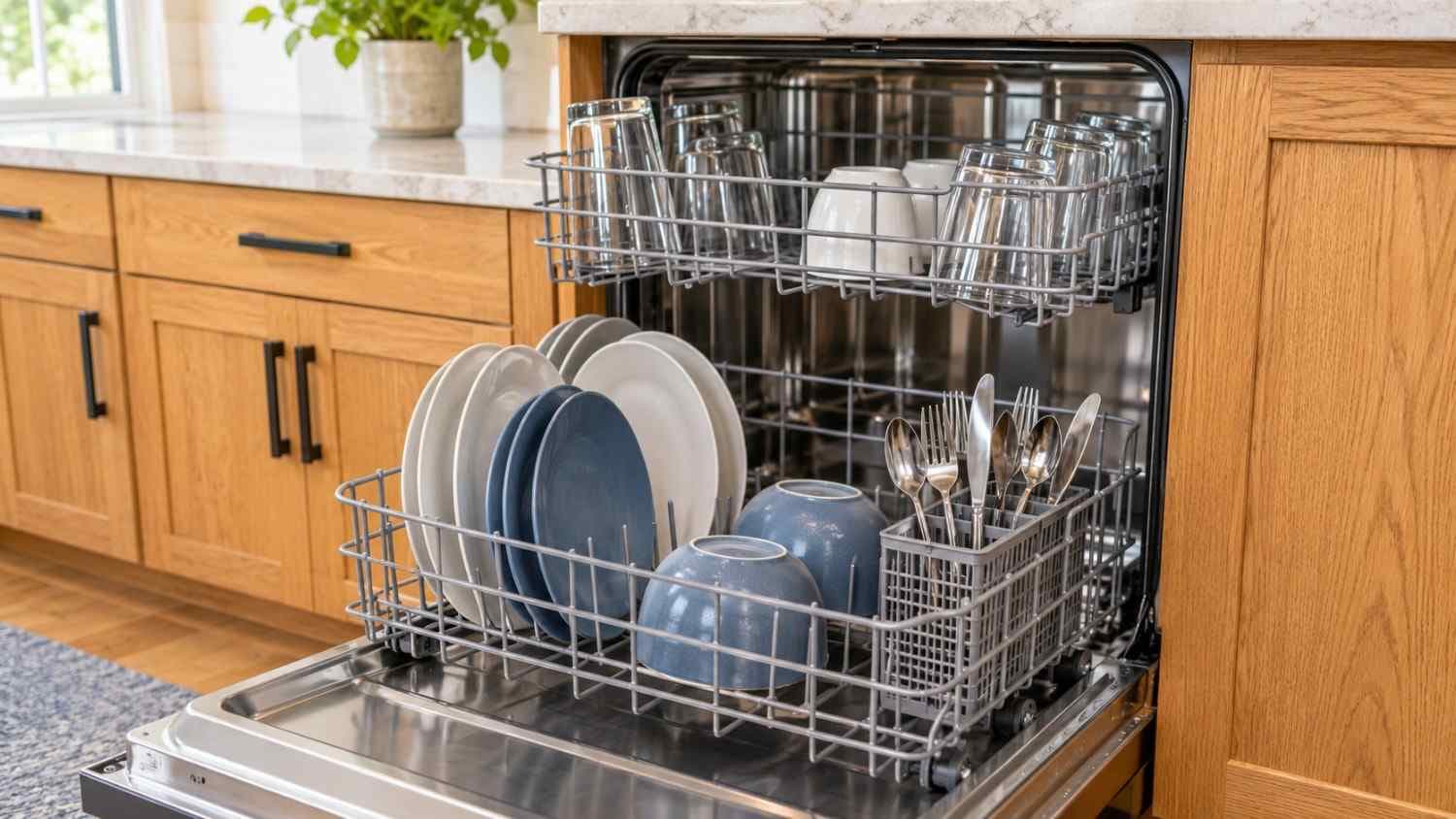
Load a dishwasher so water can reach every dirty surface and nothing stops a spray arm from turning. That is the whole principle. The six rules below put it into practice, and the rest of this guide explains why they work, where manufacturers disagree, and what to check when dishes still come out dirty.
- Scrape, don’t rinse. Remove bones, seeds and scraps, then load.
- Put big, dirty items on the bottom rack, angled down and toward the centre.
- Put cups, glasses and dishwasher-safe plastics on the top rack, upside down or face down.
- Keep everything apart. Nothing stacked, nested or touching.
- Spin each spray arm by hand to confirm it turns freely.
- Run the kitchen tap until hot, then start the cycle.
If dishes still come out dirty after all that, the cause is usually the filter, clogged spray arm jets, detergent and rinse aid, or your water. Where you live matters here: both water utilities serving the Fallbrook area publish “very hard” water figures, and hard water can undo perfect loading. The second half of this guide helps you work out which problem you have.
Before you load
Scrape, don’t rinse. The U.S. Department of Energy’s dishwasher guidance is to scrape loose food and load without rinsing when your machine and detergent are modern; if you rinse at all, keep it light.
ENERGY STAR gives the same advice and adds that if dishes will sit overnight, use the dishwasher’s own rinse feature instead of the faucet.
There is a mechanical reason too. Whirlpool explains that detergent is formulated to work on food soils, and that some models have a soil sensor that sets the cycle according to how dirty the dishes are.
It follows that heavily pre-rinsed dishes give those sensors less to read, though Whirlpool doesn’t say it in those words.
Reasonable exceptions:
- Burned-on or dried-on food. A quick soak or a firmer scrape is sensible.
- Dishes that will wait overnight. Use the machine’s rinse cycle.
- An older machine. The American Cleaning Institute says scrape-only applies to dishwashers made in the past ten years, so with an older unit a light rinse on badly soiled items is a fair precaution.
Three more checks take under a minute:
- Look at the filter. Food caught there leaves grit on dishes.
- Run the hot tap first. Consumer Reports recommends running the sink tap until the water is hot so the cycle doesn’t begin with cold water.
- Put detergent in the dispenser, not loose in the tub.
Rack layouts differ by model, and many manuals include a loading diagram for yours. Where this guide and your manual disagree on a specific point, follow the manual.
How a dishwasher actually cleans
A dishwasher doesn’t scrub. Water is pumped to spray arms that rotate and fire jets at whatever is within reach. A dish gets clean only if jets can reach its dirty surface, the water is hot and carries enough detergent, and the arms can turn freely.
Almost every loading rule follows from that:
- Dirty surfaces face the centre because that’s where the arms are.
- Bowls and cups face down so jets reach the inside and water drains out.
- Nothing nests, because water can’t get between stacked surfaces.
- Tall items stay clear of the arms, because a blocked arm stops spraying.
How to load each rack
Whirlpool’s loading guide and the American Cleaning Institute agree on most of the following.
Bottom rack
- Dinner plates go between the tines, dirty face toward the centre, tilted slightly down. Alternate large and small plates so they can’t nest.
- Large bowls and mixing bowls go at the back or sides, with the inside facing the centre and angled down.
- Pots, pans and dishwasher-safe baking dishes go at the sides or back, angled down, with baked-on food facing the spray.
- Flat pans and platters go at the sides or back, never in front of the door, where they can block the detergent dispenser.
- Tine spacing matters. Tom’s Guide notes that the wider gaps on lower racks suit bowls and the tighter ones suit plates.
Top rack
- Mugs and glasses go upside down along the sides, resting between the tines, not over them.
- Stemware goes in the stem holders if your rack has them.
- Small bowls and plates go between tines, angled down toward the centre.
- Plastics go on the top rack only, and only if marked dishwasher-safe. Whirlpool says this keeps them away from the heating element, and ACI says the bottom of the machine runs hotter. Make sure small pieces can’t fall through.
- Long utensils (spatulas, ladles) lie flat on the top rack, where they can’t slip through or jam an arm.
- Third rack, if you have one: it suits flat utensils and small items. Angle mugs and bowls to face the arms, and check nothing hits the rack above.
Cutlery
Keep pieces separated so nothing nests. If your basket has a divider lid, leave it on, because removing it to fit more in leaves pieces touching. Knives go blade down and handle up so you don’t cut yourself unloading. Good chef’s knives are better washed by hand.
A worked example: loading a family dinner
This is illustrative, not a client case.
- Start with the stockpot and sheet pan (if dishwasher-safe) at the back and sides of the bottom rack, tilted down.
- Slot four dinner plates between the tines, facing the centre.
- Fill remaining slots with four bowls, angled down and not nested.
- Move to the top rack: four glasses upside down along the sides, plastic containers face down, spatula flat.
- Put forks and spoons in the basket, mixed so none nest, with knives blade down.
- Spin both arms, check the dispenser door, run the tap hot, start.
Where guidance disagrees
Loading advice isn’t uniform. Here’s how the main disagreements break down:
- Forks and spoons, handles up or down? Whirlpool says handles down for proper cleaning, and Consumer Reports agrees. ACI recommends knives and forks head down for safety, which puts a fork’s handle up. The trade-off is cleaning exposure against safe unloading. Follow your manual, and mix orientations so pieces don’t nest.
- Dirty side toward the centre? Whirlpool and ACI both say yes. Consumer Reports reported in 2015 that GE said newer racks don’t require it, and added that you should follow your manual on this. Default to the centre unless your manual says otherwise.
- Knives. Whirlpool lists kitchen knives among items to hand-wash, yet also tells you how to load them if they do go in. Sharp or valued knives by hand; others blade down.
- Plastics. Top rack only, per both Whirlpool and ACI, and only if marked dishwasher-safe.
The 20-second check before you press start
Most “the bottom never gets clean” complaints come down to a blocked arm or a blocked dispenser. This check catches both.
- Spin each spray arm gently by hand. KitchenAid’s support guidance is that if an arm doesn’t turn easily, you should reload. If something catches, move it, or raise the upper rack if yours adjusts.
- Look at what’s near the upper arm: handles, ladles and the tops of tall pans.
- Make sure the detergent door can swing open. A flat pan in front of it is the usual culprit.
- Confirm bowls and cups face down and nothing is nested.
- Run the hot tap, then start.
Your water: what Fallbrook’s numbers say
Water hardness is the dissolved calcium and magnesium in your water, reported in milligrams per liter (mg/L, the same as ppm) or grains per gallon (gpg). To convert, divide mg/L by 17.1.
The U.S. Geological Survey’s hardness scale puts soft water at 0 to 60 mg/L, moderately hard at 61 to 120, hard at 121 to 180, and very hard above 180. The “very hard” line of 180 mg/L is about 10.5 gpg.
What the local utilities report:
- Fallbrook Public Utility District. Its 2026 Water Quality Report says hardness averaged 235 mg/L in 2025, which it converts to 13.7 gpg and classes as very hard. Readings in the distribution system ranged from 200 to 270 mg/L. Water purchased from Lake Skinner averaged 242 mg/L, and locally sourced groundwater treated at the Santa Margarita plant averaged lower, at 187 mg/L. So the number at your tap can vary by location and through the year.
- Rainbow Municipal Water District. Its June 2026 report gives an average of 230 mg/L (13.45 gpg), range 228 to 232, also very hard. If you’re in the Rainbow area, your bill tells you which utility’s report applies.
A quick calculation puts that in context: 235 ÷ 17.1 ≈ 13.7 gpg. That sits roughly 28 to 30 percent above the 180 mg/L line where very hard begins. Municipal water here isn’t borderline; it’s solidly in the top band.
On a private well, neither report applies. A well can be harder, softer, or carry iron and sediment, so test it instead of assuming. Our well water appliance service page explains what we check on well-served properties.
What hard water changes about how you load and run it
Water left behind dries into spots. This is reasoning rather than a tested result: anything that holds water at the end of a cycle, such as an upturned cup, a flat lid or nested bowls, is a likely spotting site, and that’s why angling and face-down loading matter more with hard water.
Rinse aid helps too, because it helps water sheet off dishes, which reduces spotting and speeds drying.
Scale blocks the jets. Mineral deposits can clog the small holes in spray arms, and a clogged arm sprays weakly even when nothing is blocking it. Service guidance suggests clearing the holes with a toothpick or skewer, and in hard-water homes using a dishwasher cleaner monthly.
Check your manual first, since some arms come off and some don’t. We cover how scale affects appliances more broadly in our post on how Fallbrook’s hard water damages appliances.
Dose detergent to the label, not to your frustration. Whirlpool advises filling the dispenser according to your hardness, and about halfway if you don’t know it.
It also warns that hard water plus too much detergent can cloud glassware. The same over-dosing trap shows up in washers; our post on using too much detergent in HE washers explains it.
Check whether your machine has its own softener. Some dishwashers have a built-in softener with a salt compartment and a hardness setting.
If yours does, set it per the manual to the band that covers your number. For a whole-house approach, see our guide to water softener sizing for Fallbrook properties.
Film or etching? Whirlpool’s troubleshooting lists hard water, too much detergent and poor loading as the causes of film on glass.
A commonly used test is to rub a little white vinegar on one cloudy spot. If it clears, it’s mineral film and the steps above apply. If it doesn’t, the glass may be etched, which is permanent.
Why are my dishes still dirty? Match the pattern
Where the dirt shows up usually points to the cause. EasyBear’s diagnostic guide notes that dirt in the same area every load suggests loading or an arm that can’t turn, gritty residue suggests a blocked filter or arm, and film suggests rinse aid, hard water or cool incoming water.
- The same spot is dirty every load. An item is blocking an arm or the dispenser, or the jets nearby are clogged. For example (hypothetical), if the back-left of the bottom rack is always dirty, check whether a tall pot handle is stopping the upper arm. Reposition, spin-test, and look at the jets.
- One rack is always worse than the other. That rack’s arm isn’t spinning, or its holes are blocked. Remove the arm if your manual allows and look at the jets.
- Gritty residue on dishes. Clean the filter and clear the arm holes.
- White film, haze or spots. Check the rinse aid level, your detergent dose, and whether the water started hot. Then run the vinegar test.
- Dishes are clean but wet. That’s a drying problem, not a cleaning one. Check rinse aid, and angle items so they drain.
- Baked-on food on pots and pans. Your cycle may be too light. A quick or normal cycle often won’t clean dirty cookware, so choose a heavy or pots-and-pans cycle.
- Detergent still sitting in the dispenser. The door was blocked. Move flat items away from the front of the rack.
- Everything is dirty after all of the above. That points to the pump, a sensor, the heater or heavy scale inside the machine.
On a private well there’s an extra suspect: sediment. Many homes in Bonsall and parts of Fallbrook are on wells, and our complete guide to protecting appliances from well water damage covers testing and treatment.
When it isn’t loading
If you’ve loaded correctly, passed the spin test, cleaned the filter, cleared the arm holes, used a hot tap, picked the right cycle and dosed detergent and rinse aid properly, and dishes are still dirty, the problem is mechanical or water-related. A weak wash pump, a failing sensor or a heating fault all fit that pattern.
On well-water properties, spray arm scale is the first thing we check. Our dishwasher repair page explains what we look at and the typical faults. The diagnostic visit is $89, waived if you go ahead with the repair, and you get a flat-rate quote before any work begins.
We cover Fallbrook, Bonsall, De Luz, Rainbow and Pala, Monday to Saturday, 8 am to 5 pm. Call or text (951) 717-8971 (calling before 11 am gives you the best chance of same-day service), or use our contact page.