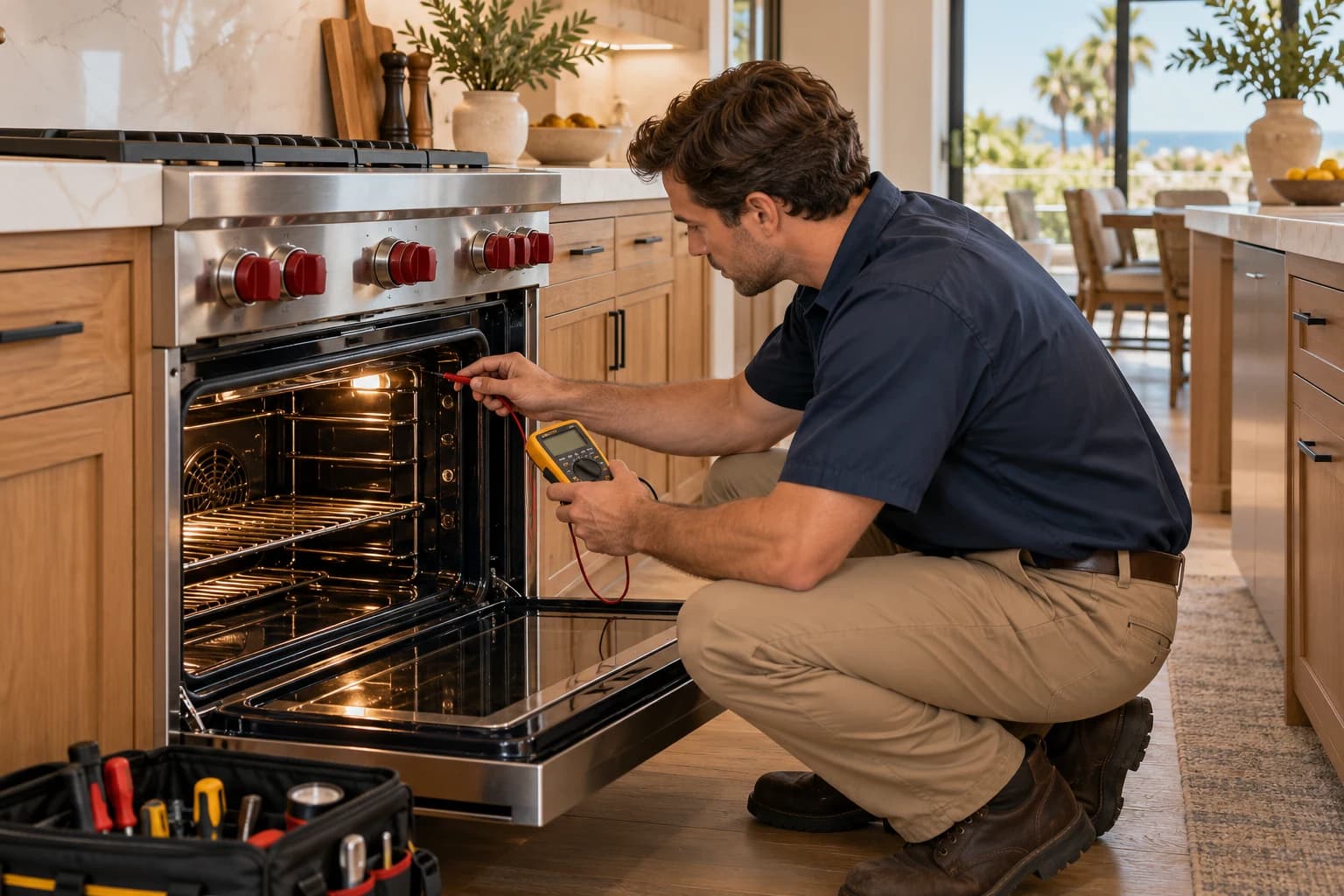

Dryer vents are a fire-safety issue everywhere. On rural Fallbrook, Bonsall, and De Luz properties they are a larger one, because the things that make a dryer fire bad, dry air, dry fuel, and distance from the fire station, are all present in greater measure, and because a house fire on a rural property can become a vegetation fire in minutes. This article covers why the rural setting compounds the vent problem, what vegetation near the outlet means, what is different about venting a propane dryer, how often to clean in fire season, and why having the dryer and the vent serviced together makes sense.
Rural fire risk compounds dryer vent concerns
Clothes dryers cause an estimated 2,900 residential fires a year in the United States, according to data published by the U.S. Fire Administration, and failure to clean is the leading contributing factor. The mechanism is simple. Lint is finely divided dry fibre, which is close to an ideal fuel. The dryer produces it continuously and pushes it, with hot moist air, through a duct. Some lint settles in the duct, the lint screen housing, and the dryer cabinet. As the duct restricts, airflow drops, the dryer runs hotter and longer, and eventually the heat source, an electric element or a gas burner, meets the lint.
Everything about a rural inland property makes that sequence worse. Fallbrook's inland climate is dry for most of the year, so lint dries out completely and ignites more readily than it would in a humid coastal laundry room. Rural homes are large and the dryer is often far from the exterior wall, so vent runs are long, with bends and vertical sections where lint collects. Laundry rooms on ranch properties are sometimes in outbuildings or garages, where a small fire can burn for a while before anyone notices. Fire response times on dirt roads in the hills are longer than in town. And the property itself, grove, chaparral, dry grass, is the next thing to catch.
The practical result is that the same dryer, with the same vent, in the same state of neglect, is a bigger risk in De Luz than in a Fallbrook subdivision. The signs of restriction are worth learning: loads that take two cycles, a dryer that is hot on top, a laundry room that gets warm and humid, a musty smell on dry clothes, lint around the outside flap, and a thermal fuse that keeps tripping. In most cases the "takes forever to dry" complaint is the vent, not the dryer, and the test is to disconnect the vent and run a cycle; if the dryer suddenly works, the vent is the fault. The dryer repair page covers that diagnosis and the fire safety recommendations in full.
Vegetation proximity considerations
Where the vent comes out of the house matters as much as what is in it. On a rural property the outlet is often at ground level on the side of the house facing the grove, or on an outbuilding wall backing onto brush, and two things happen there that do not happen on a suburban wall facing a lawn.
The first is that lint accumulates outside. A vent that is partly restricted inside still blows lint out of the flap, and it collects on the ground, in mulch, in the dry grass at the foundation, and on nearby shrubs. Lint on a dry hillside is tinder. A vent that has been expelling lint onto the same patch of ground for a year has built a fuel bed where any spark, from the dryer, from a mower, from a neighbour's burn, has something to work with.
The second is that vegetation grows into the vent. A flap that is held open by a twig cannot close, and birds and rodents nest in open vents; a nest is both a blockage and a fuel load sitting directly in the airstream of a hot dryer. Insects and spiders web across outlets through the summer. On a rural property the outlet needs inspecting from outside, not just the dryer from inside.
Defensible space guidance from CAL FIRE, published at readyforwildfire.org, calls for the area immediately around a structure to be kept clear of flammable material, and a dryer vent outlet is a good place to apply that principle deliberately: clear brush, mulch, woodpiles, and dry grass back from the outlet, keep the flap working and the outlet unscreened, since screens catch lint, and never vent a dryer into an attic, crawl space, or garage. If the outlet faces the grove or the brush, that side of the house needs the vent checked more often than the recommendations below would otherwise suggest. On properties in Bonsall and De Luz where the laundry is in a barn or outbuilding, the same applies with less margin, because nobody is standing next to it when it goes wrong.
Propane dryer specific vent considerations
Most gas dryers on rural Fallbrook properties run on propane, and propane changes the vent conversation in three ways.
Combustion products. A gas dryer, propane or natural, vents not only lint and moisture but the exhaust from its burner, including carbon monoxide and water vapour. A restricted vent on a gas dryer backs combustion products into the laundry room as well as overheating the drum. Electric dryers do not have this failure mode. A carbon monoxide alarm near a propane laundry is sensible, and a dryer that smells of exhaust needs its vent checked before anything else.
Heat and flame. The burner in a propane dryer is an open flame inside a cabinet that is accumulating lint. A blocked vent raises the temperature in that cabinet, and the thermal fuse is the safety that is supposed to intervene. A thermal fuse that keeps tripping is doing its job; replacing it without clearing the vent is how it ends up tripping again within weeks, or how the dryer ends up running at a temperature the fuse should have stopped.
Propane components under heat stress. Overheating from a restricted vent stresses the high-limit thermostat and the gas valve coils, and repeated late light-offs in an overheated cabinet soot the burner and foul the flame sensor. Propane-rated parts are specific and less likely to be on a generalist's vehicle; a propane dryer repair that does not include a vent inspection is incomplete, which is why vent inspection is part of every dryer call here regardless of fuel.
The vent itself is the same: rigid or semi-rigid metal duct, not plastic or foil, as short and straight as possible, with joints taped rather than screwed so screws do not catch lint, and an outdoor termination with a working flap and no screen. Propane dryers that were converted from natural gas should have been converted with the manufacturer's kit; a dryer running a lazy yellow flame has a fuel problem on top of any vent problem, and the two together are the worst case.
Fire season frequency recommendations
How often a vent needs cleaning depends on how much the dryer runs and what is outside the outlet.
- Annually for a standard household on an ordinary property, as a minimum, with the lint screen cleaned every load and the screen housing brushed out monthly.
- Every 6 to 8 months for high-use households: large families, properties with guest quarters sharing a laundry, anyone washing livestock blankets and work clothes daily.
- Every 3 to 4 months during fire season for rural properties with vegetation exposure near the vent outlet, which describes most of Bonsall, De Luz, Rainbow, and the hills around Fallbrook. Fire season here runs from late summer through the Santa Ana months of autumn and into early winter in dry years, and that is when both the lint and the landscape are driest.
The outside of the vent, the outlet, the flap, and the ground beneath it, should be looked at monthly through fire season regardless of when the duct was last cleaned, because that is where the lint meets the landscape. Cleaning the lint screen with warm soapy water occasionally, not just brushing it, removes the fabric softener film that restricts airflow while looking clean.
A professional vent cleaning on a rural property runs $150 to $250 depending on the length of the run and access, and includes the dryer's lint housing and the outlet, with airflow checked afterwards. On a long run through an attic or a crawl space, or one with several bends, that is the only way to know the duct is actually clear.
Combined dryer and vent service on rural properties
On a property that is 90 minutes from the nearest service vehicle, a trip that fixes the dryer and leaves the vent restricted is half a repair, and a trip that cleans the vent and leaves a failing igniter is the other half. The two are inseparable on a rural call, and they are handled together.
Every dryer repair call includes a vent inspection, whatever the fault reported. If the vent is restricted, cleaning is quoted on the spot and done on the same visit, so the repaired dryer is not immediately overheated by the duct that contributed to the fault. If the vent is the whole problem, which it is in most "takes two cycles" calls, the diagnostic finds that without replacing any part. On propane dryers the visit also covers propane pressure verification and a tank level check, and the propane-compatible igniters and valve coils for the common brands are on the vehicle, so most propane dryer repairs are completed in one trip.
The diagnostic is $89, waived if you proceed with a repair, with a $30 rough-road surcharge for properties beyond paved roads, stated at scheduling. Vent cleaning is $150 to $250. Repairs run $180 to $400 for the usual dryer faults and carry a 90-day parts and labour warranty. Same-day service is available for calls received before 11 am in Fallbrook; Bonsall is typically 60 to 90 minutes from booking, and De Luz and Rainbow may need next-day scheduling. If a dryer smells of burning at any point, turn it off, leave it off, and call (951) 717-8971. In this climate, with the grove a few feet from the vent, that is not a smell to run one more load through.